Thursday, August 27, 2009

Adding English and Spanish subtitles to the first Tonatiuh video


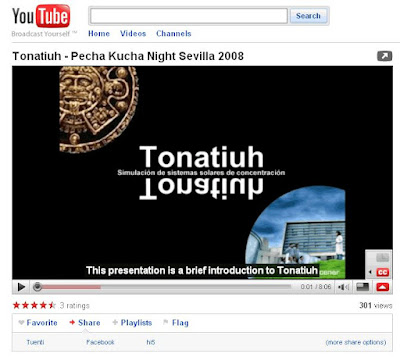
We just added subtitles in English and in Spanish to the Tonatiuh - Pecha Kucha Night Sevilla 2008 video using the close caption feature offered by YouTube.

As stated in YouTube Help:

“Captions and subtitles make videos accessible to a wider audience by allowing folks who can not otherwise understand the audio track to follow along, especially those who are hard-of-hearing or speak other languages. Captions are in the same language as the video's audio track. Subtitles are in a different language.”

To activate the captions / subtitles option, you just have to click on the button labeled “CC” at the lower right corner of the YouTube player. Further and more detail instructions on how to do it can be found here:

Sunday, August 23, 2009

Tonatiuh video channel started on YouTube

We have just started a video channel on YouTube about Tonatiuh. Our plan is to use it to upload videos about Tonatiuh in a regular basis -mostly tutorials to help Tonatiuh users better understand the program, and how to use it.

The first video was just uploaded few days ago. It is an eight minutes static pictures presentation about the rationale for the Tonatiuh software development project; the principles and goals that inspire its open source development, and the program structure, and current status. It is based on a presentation given by me at the Seville's Pecha Kucha Night September 2008.

After this introductory video, others will follow of a more tutorial-like character. If you want to be informed when this videos are available just subscribe to our YouTube channel:

http://www.youtube.com/user/TonatiuhRaytracer

Saturday, July 4, 2009

Activities for week 27 of 2009 (06/29-07/03)

This week we plan to finish a paper for the 2009 SolarPACES conference in Berlin, presenting the results of a preliminary comparison between Tonatiuh and SolTRACE, which is a optical analysis program developed by NREL to analyze the optical behavior of solar concentrating systems.

Basically, what we have done is to simulate three concentrating systems with both programs, and compare the results. The concentrating systems simulated are simplified versions of:

  • The EuroDish parabolic dish.
  • The LS3 parabolic trough.
  • The NREL' SolarFurnace

During this week we will finish the analysis of the results provided by the programs, draw the appropriate conclusion, and include them in the SolarPACES paper, complementing the written presentation with tables, and graphics where appropriate.

Amaia will run the Tonatiuh simulations, Pierre and Rakel the SolTRACE simulations, and Manuel, with the support of Victor, will finish writing the paper for SolarPACES, and will upload it to the SolarPACES website.

Wednesday, June 24, 2009

Activities for week 26 of 2009 (06/22-06/26)

This week we plan to improve Tonatiuh and its support infrastructure in the following ways:

  1. The development team will discuss and agreed upon a versioning scheme for the program, since it is long over due.
  2. Victor will carry out a thorough review of Tonatiuh Unit Tests.
  3. Amaia and Manuel will review the main wiki at tonatiuh.googlecode.com to correct detected errors and increase consistency.
  4. Manuel will add to the this blog a slide show of Tonatiuh and Tonatiuh related Mathematica screen captures, to provide a feeling of Tonatiuh's GUI and flux calculation capabilities.

Wednesday, April 22, 2009

Status of Tonatiuh as of April 22, 2009

Currently, Tonatiuh can be used to simulate only reflective solar concentrating systems. Fortunately, this suffices to simulate most of the solar concentrating systems used by the CSP industry nowadays.

The collection of plug-in surfaces developed so far, allow the modeling of a large variety of solar concentrating geometries, e.g. static CPC’s, one-axis tracking parabolic troughs, two-axis tracking parabolic troughs and heliostats. Furthermore, the complexity of the concentrating systems to be modeled can be as large as desired.

The only sunshape plug-in developed so far is a pillbox sunshape. Two types of sunlight emitting surfaces can be used in conjunction to the pill box sunshape: a flat square, and a flat disk.

Possible atmospheric interactions with the light bouncing within the system (e.g. absorption and scattering) are not modeled yet. For large systems, in which the mean free-path of photons before reaching their target are of the order of few hundreds of meters, this could be a non-negligible source of error. However, for small size solar concentrating systems this error is not relevant.

The plug-in and library based architecture of the program allows for easy modification and maintenance. This architecture will make it possible to easily increase Tonatiuh’s functionality in order to overcome the limitations referred above, and to further increase the value of the program to their users.

Monday, April 28, 2008

Objectives of Tonatiuh

As stated in the Concentrating Solar Power section of the “Solar Program Multiyear Technical Plan 2003-2007 and beyond”, many of the existing models used for the technical and economic analysis of parabolic-trough and solar tower systems need to be updated and validated. This includes models for collector optics and thermal performance, among others.

The Tonatiuh software development project is intended to improve the cost-effectiveness of solar energy technologies by advancing the state-of-the-art of the simulation tools available for the design and analysis of solar concentrating systems.

When completed, it is intended that Tonatiuh, will:

- Provide a unifying computational paradigm for the simulation and analysis of virtually any type of solar concentrating system that may be envisioned;

- Be extremely user-friendly, easy to adapt, expand and maintain; and

- Be able to take advantage and efficiently handle any computer power available to it.

Saturday, April 26, 2008

Welcome

Welcome to the Tonaituh Chronicles!

This blog is intended to foster collaboration and information exchange among the members of the Tonatiuh software development team. 

It is conceived to facilitate coordination and collaboration among team members, and as a general repository of information relevant to the development of Tonatiuh,  or to the understanding and documentation of the program.

If you are interested in joining the team, please let us know.

Best regards,